Lighting Guides
How to Choose a Street Light Glass Lens for Wide Roads
Wide roads need wider beams and tighter glare control. This guide explains asymmetric angle, beam width and uniformity, so you can match a ZG107 lens to a wide one-side or two-side road.
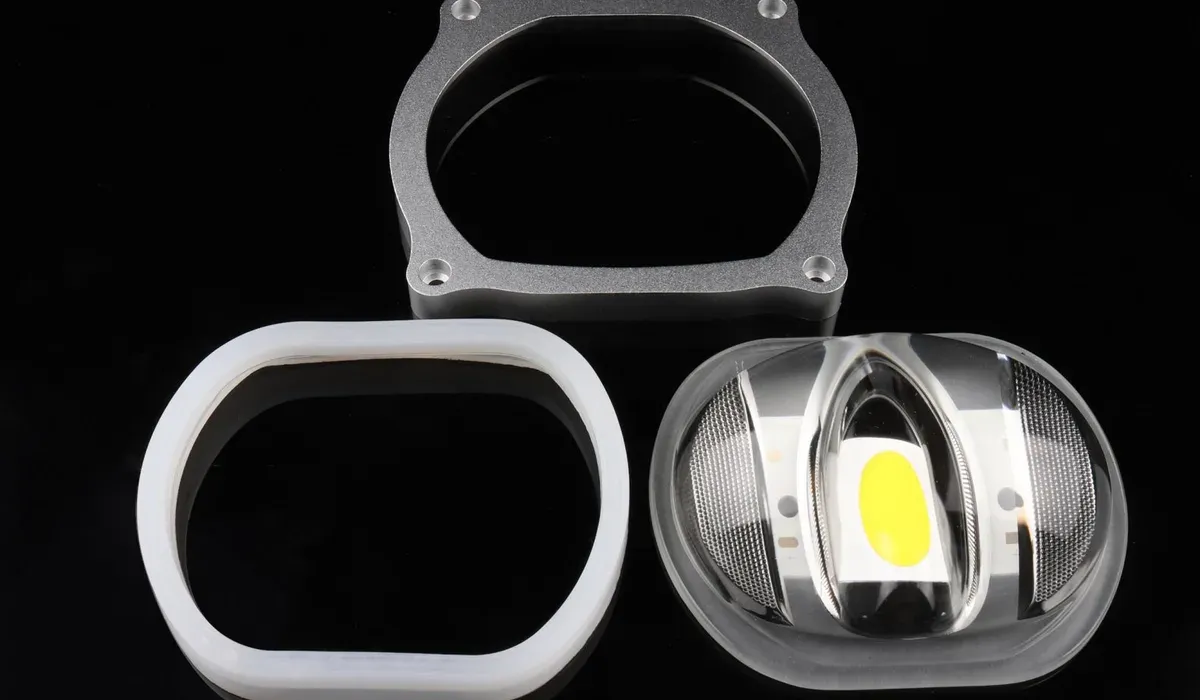
Wide roads need more light spread across the road surface, and more care with glare. A lens that works on a narrow street can leave dark patches or throw light where drivers do not need it on a wide road. This guide explains how beam width, asymmetric angle and uniformity work together, so you can match a ZG107 lens to a wide one-side or two-side road.
Why wide roads need a different lens
On a wide road the light must travel further across the surface and cover more lanes from the same pole. A narrow beam leaves the far side dark, while a beam that is too wide wastes light beyond the road edge. The lens has to spread the light evenly across the full width while keeping glare low for drivers.
Type II Medium distribution and what it does
Type II Medium distribution is designed for street and road lighting. It throws the light in a long, wide pattern along the road and across its width, instead of a round pool of light. All eight ZG107 variants share this distribution, so the choice between them is about beam width, asymmetric angle and catalogue results, not about the distribution type.
Beam width: 140° or 150° or 160°
ZG107 variants come in beams from 60° x 140° to 80° x 150°, with one variant reaching 60° x 160°. A wider beam covers a wider road from the same mounting position. Match the beam to the road width: the wider the road, the wider the beam you need, and the catalogue results show how each variant performs.
Asymmetric angle: 0° to 30°
The asymmetric angle is the angle at which the light is pushed across the road. ZG107 variants offer asymmetric angles from 0° to 30°. A larger asymmetric angle throws the light further across the road, which suits wide roads and poles with a long overhang. A 0° variant suits roads where the light does not need to reach so far sideways.
Uniformity and glare: U0, UI and TI
Uniformity and glare decide how comfortable the road looks to drivers. U0 is overall uniformity and UI is longitudinal uniformity — higher is better. TI is the threshold increment, a measure of glare — lower is better. ZG107 variants range from U0 0.51 to 0.74, UI 0.77 to 0.94, and TI 8 to 13, so always check the exact variant, not the series average. The micro-structures on the lens surface keep glare extremely low, and there is no luminous intensity above 80°.
LED power and luminous surface: 30–200 W
All ZG107 variants are made for 30–200 W LED or COB sources, with luminous surfaces of Φ22–30 mm and 24x24–27x27 mm. Check that your LED or COB matches both the power range and the luminous surface size before choosing a variant, because the optical design is built around that source size.
One-side roads, two-side roads and pole overhang
ZG107 lenses suit one-side roads and two-side roads, and poles with 1 to 2.5 m overhang. The overhang decides how far the luminaire sits over the road, and together with the asymmetric angle it decides how well the far side is lit. Tell Glasvio your road layout and pole overhang when you ask for a variant recommendation.
Checklist: matching a ZG107 lens to your road
Work through the checklist below before you order. If any answer is unclear, confirm it with Glasvio first — the catalogue does not explain what the A and B suffixes mean, so the exact variant should always be confirmed before ordering.
- Decide whether the road is one-side or two-side, and the pole overhang (1–2.5 m).
- Pick the beam width for the road width: 140°, 145°, 150° or 160°.
- Pick the asymmetric angle (0° to 30°) for how far the light must reach across the road.
- Check U0, UI and TI for the exact variant — ZG107 variants range U0 0.51–0.74, UI 0.77–0.94, TI 8–13.
- Confirm the exact A or B variant with Glasvio before ordering — the catalogue does not explain A or B.
Learn more: